
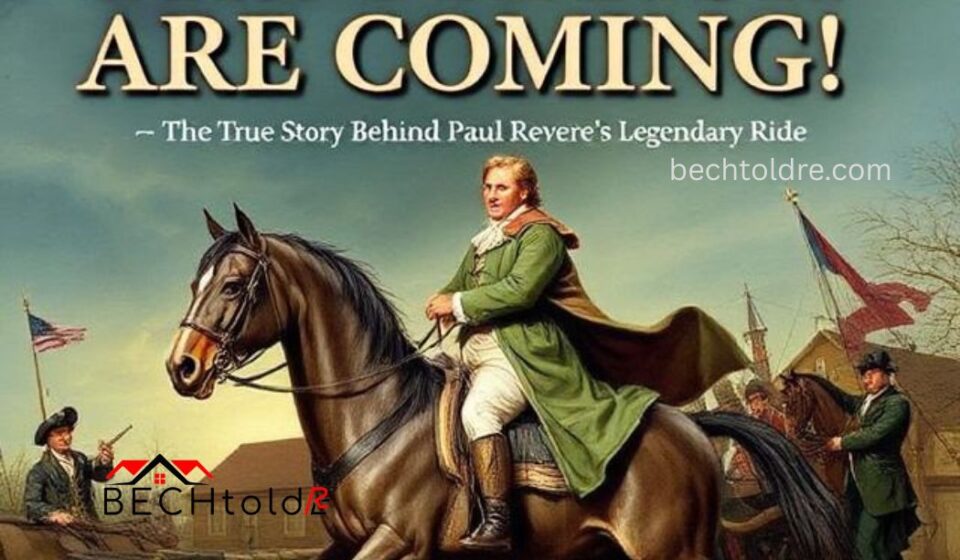

On the night of April 18, 1775, a lone horseman galloped through the Massachusetts countryside, shouting warnings to sleeping colonists. Those three words — “The British are coming!” — have become shorthand for vigilance, courage, and the spark of the American Revolution.
But here’s the twist: Paul Revere almost certainly never said it.
In this deep-dive, we’ll separate fact from folklore. You’ll learn what really happened on Revere’s midnight ride, how a 19th-century poem created a national legend, and why the phrase “the British are coming” still resonates today.
The Real Midnight Ride: What Actually Happened?
By April 1775, tensions between the American colonies and the British Crown had reached a boiling point. General Thomas Gage, the British military governor of Massachusetts, planned a secret mission: march 700 soldiers to Concord and seize the colonists’ hidden weapons cache.
American spies learned of the plan. The task of warning the countryside fell to two men: Paul Revere and William Dawes.
The Route and Riders
-
Paul Revere was rowed across the Charles River to Charlestown, where he borrowed a horse and began his ride toward Lexington.
-
William Dawes took the longer land route out of Boston.
-
A third rider, Dr. Samuel Prescott, later joined them.
Their primary targets were John Hancock and Samuel Adams, who were hiding in Lexington. Second, they needed to alert Concord’s militia.
Revere’s Capture
Revere made it to Lexington around midnight, warning Hancock and Adams. He and Dawes then rode toward Concord, but at a roadblock near Lexington, British patrols captured Revere. He was questioned and released without his horse. Dawes and Prescott escaped — Prescott alone reached Concord to warn the militia.
The next morning, April 19, the first shots of the Revolution were fired at Lexington Green. By then, thanks to the riders, colonial militiamen were ready.
Key fact: Revere never completed his ride to Concord. Yet his name became synonymous with the event — thanks largely to the power of poetry.
Did Paul Revere Say “The British Are Coming”? (Spoiler: No)
Historians agree that Revere would not have used the phrase “the British are coming.” Why? Because in 1775, American colonists still considered themselves British subjects. Shouting “The British are coming!” would have been confusing — to whom else would he be referring?
What Revere Actually Said
Based on Revere’s own written account of the ride, he warned: “The Regulars are coming out.” (“Regulars” meant British soldiers.) Other accounts use “Redcoats.” The phrasing was precise: he needed to signal the enemy, not cause panic about the British Crown itself.
The famous misquote emerged decades later, likely because it’s simpler, more dramatic, and clearly identifies the “us vs. them” of the Revolution.
Source: Paul Revere’s 1798 letter to Jeremy Belknap, housed at the Massachusetts Historical Society, describes his warnings as “The Regulars are coming out.”
The Man Who Made the Myth: Henry Wadsworth Longfellow
If not for one poet, Paul Revere might be a footnote. Henry Wadsworth Longfellow’s 1861 poem, “Paul Revere’s Ride,” transformed a modest silversmith into an American hero.
Why Longfellow Wrote It
Longfellow published the poem just as the Civil War was beginning. He wanted a patriotic story to inspire Northerners — a lone hero sounding an alarm against a powerful enemy. The poem took enormous creative liberties:
| In the Poem | Historical Reality |
|---|---|
| Revere rides alone | Dawes and Prescott rode too |
| He shouts “The British are coming!” | He said “The Regulars are out” |
| He makes it to Concord | He was captured before reaching Concord |
| One lantern signals “by sea” | That part was accurate — but Revere didn’t hang the lanterns (a sexton did) |
Longfellow’s goal wasn’t history. It was morale. And it worked — so well that the fictional version replaced the real events in the popular imagination.
Why the Phrase “The British Are Coming” Endured
Myths often outlive facts because they’re stickier. The phrase “the British are coming” has become a cultural shorthand for:
-
Urgent warnings – It’s used in headlines, politics, and business to signal an impending threat or change.
-
American defiance – The idea of a lone patriot risking everything to rally resistance.
-
Dramatic storytelling – Three words, easy to remember, full of tension.
Modern Uses of the Phrase
-
In movies (e.g., National Treasure, The Patriot)
-
As political slogans (“The socialists are coming!” — borrowing the formula)
-
In marketing campaigns for revolutionary products
Even though it’s historically inaccurate, the phrase captures the spirit of April 1775 better than “The Regulars are out” ever could.
Lessons From the Myth vs. History
The story of “the British are coming” teaches us something important: history is what happened; legend is what we remember.
| Historical Truth | Legendary Version |
|---|---|
| Coordinated effort of several riders | One heroic lone rider |
| Military warning (“Regulars”) | Political rallying cry (“The British”) |
| Revere captured before Concord | Revere the triumphant messenger |
Does the myth harm history? Not necessarily — if we treat it as a story worth questioning. The real ride was even more impressive: a network of ordinary colonists, including two other riders, who succeeded against the odds.
Frequently Asked Questions (FAQ)
Who actually warned “The British are coming?”
No one. The phrase became popular thanks to Longfellow’s 1861 poem. Paul Revere warned “The Regulars are coming out.”
Is Paul Revere’s ride historically accurate?
The basic facts are true: he rowed across the Charles, borrowed a horse, warned Lexington, and was captured. But the popular version (lone rider, famous phrase, success) is largely poetic invention.
Why do we remember Paul Revere and not William Dawes?
Longfellow’s poem focused exclusively on Revere. Dawes didn’t have a famous poet to immortalize him, though his role was equally important.
Did the lanterns say “one if by land, two if by sea”?
Yes — that part is accurate. Revere arranged for signal lanterns in the Old North Church to warn Charlestown which route the British were taking.
Where can I visit Paul Revere’s sites today?
Boston’s Freedom Trail includes Paul Revere’s House (still standing) and the Old North Church. Minute Man National Historical Park in Concord preserves the ride’s route.
Conclusion: Remember the Truth, Celebrate the Legend
The next time you hear someone shout “The British are coming!” — in a movie, a speech, or a meme — you’ll know the real story. Paul Revere was brave, but he didn’t ride alone. He didn’t use those words. And he didn’t finish the mission.
Yet the symbol matters. That night, ordinary people lit lanterns, rowed across dark rivers, and rode through enemy territory because they believed in something bigger than themselves.
That’s the truth behind the myth. And it’s worth remembering both.