
Few modern dystopian novels have infiltrated pop culture as deeply as Suzanne Collins’ The Hunger Games. On the surface, it’s a thrilling story of a girl who volunteers for a deadly tournament. But underneath the action and romance lies a labyrinth of powerful symbols.
Collins, a writer with a background in classics and military history, packed the trilogy with metaphors about power, sacrifice, and identity. Whether you are writing an essay or simply revisiting Panem, understanding these symbols changes the way you see the story.
Here is the breakdown of the most critical symbolism in The Hunger Games.
1. The Mockingjay: From Accident to Revolution
The most obvious symbol is the Mockingjay, but its meaning evolves dramatically.
-
What it is: A hybrid bird created when a failed Capitol experiment (the Jabberjay) mated with a wild mockingbird.
-
The Symbolism: The Capitol did not intend to create the Mockingjay. It represents unintended consequences. The Capitol tried to spy on the districts using Jabberjays, but the birds backfired. When they abandoned them, nature took over.
-
The Shift: When Katniss wears the pin, it starts as a symbol of survival. By Catching Fire, it becomes a symbol of defiance. By Mockingjay, it has become a symbol of leadership. The key takeaway? You cannot control nature, and you cannot control the human spirit.
2. Bread: The Language of Sacrifice
Bread is not just food in Panem; it is the alphabet of love and debt.
-
The Burned Bread (The Hob): When Peeta burns bread on purpose to give to a starving Katniss, it represents unconditional sacrifice. It is the act that creates the “debt” Katniss feels she owes him.
-
The District 11 Bread: After Rue dies, District 11 sends Katniss a loaf of bread. This symbolizes gratitude and solidarity. It is the moment the uprising shifts from a personal story to a political movement.
-
The Capitol’s Excess: In contrast, the Capitol eats ridiculous, elaborate pastries and genetically engineered food. This contrasts the corruption of excess against the dignity of survival.
3. The Girl on Fire: Identity vs. Performance
Katniss is never actually on fire. The “Girl on Fire” is a costume designed by her stylist, Cinna.
-
The Symbolism: Fire represents destruction, passion, and rebirth. The Capitol intends for the fire costume to be a spectacle—a pretty light for the audience to enjoy.
-
The Subversion: Katniss subverts this. She turns the spectacle into a weapon. When she becomes “the girl on fire,” she uses that heat to burn down the Games. Cinna’s design—specifically the mockingjay suit that transforms into a black mockingbird—symbolizes that real identity cannot be manufactured by the Capitol.
4. Rue & The Flowers: Lost Innocence
Rue is arguably the most tragic figure in the first book, and her symbolism is layered.
-
The Name: Rue is a plant used for medical purposes, but also a verb meaning “to regret.” Her death is the ultimate regret of the system.
-
The Flowers: When Rue dies, Katniss covers her body with wildflowers. In the Capitol, flowers are decorative. In the arena, flowers become a funeral rite. This act symbolizes the humanity that the Capitol tries to erase. Katniss refuses to let Rue be just a piece of data on a kill screen.
5. The Arena: The Cage of Spectacle
The Hunger Games arena looks like a forest, but it is a controlled, geometric cage.
-
The Symbolism: The arena is a metaphor for capitalist exploitation and reality TV. The Gamemakers control the weather, the animals, and the food. They turn suffering into entertainment.
-
The Clock (Catching Fire): In the second book, the arena is literally a ticking clock. This symbolizes that the rebels are running out of time, but also that the Capitol’s control is mechanical—and machines can be broken.
6. President Snow’s Roses: The Scent of Control
President Snow is rarely seen without a white rose in his lapel.
-
The Symbolism: Roses represent beauty, love, and romance. But Snow’s roses smell like blood and rotting meat because he holds them so close to his mouth (to cover his blood-tainted breath).
-
The Meaning: This symbolizes the rotten core beneath a beautiful facade. The Capitol is the rose: gorgeous on the outside, putrid on the inside. When Snow leaves the rose on the dining table for Katniss, it is a threat: I will kill the beauty you love.
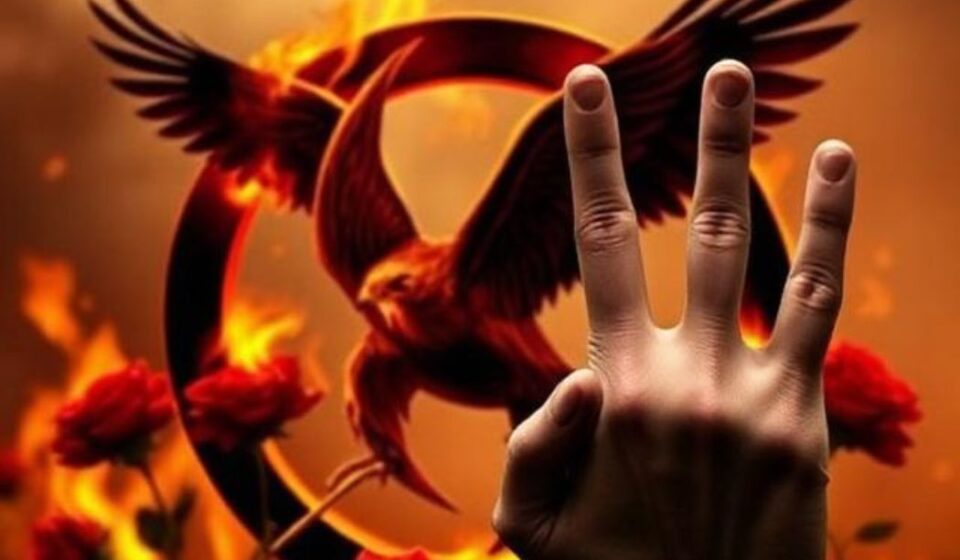
7. The Three-Finger Salute: Unity in Defiance
Originally a gesture from District 12 to say “thank you” or “admiration,” it transforms into the ultimate act of rebellion.
-
The Symbolism: It represents the power of the many over the power of the one. One person saluting is polite. A district saluting is dangerous.
-
The Weight: When the districts salute Katniss, they are not just saluting her; they are saluting the idea that the districts could be united.
The Final Takeaway
The genius of Suzanne Collins’ symbolism is that nothing is arbitrary. The Mockingjay is not a majestic lion; it is a scrappy, messy survivor. The bread is not a trophy; it is a tool of empathy.
The Hunger Games teaches us that symbols have power only if the people believe in them. When the Capitol stopped controlling the narrative, the Mockingjay flew away.
What symbol from the series resonates most with you? Drop a comment below.