
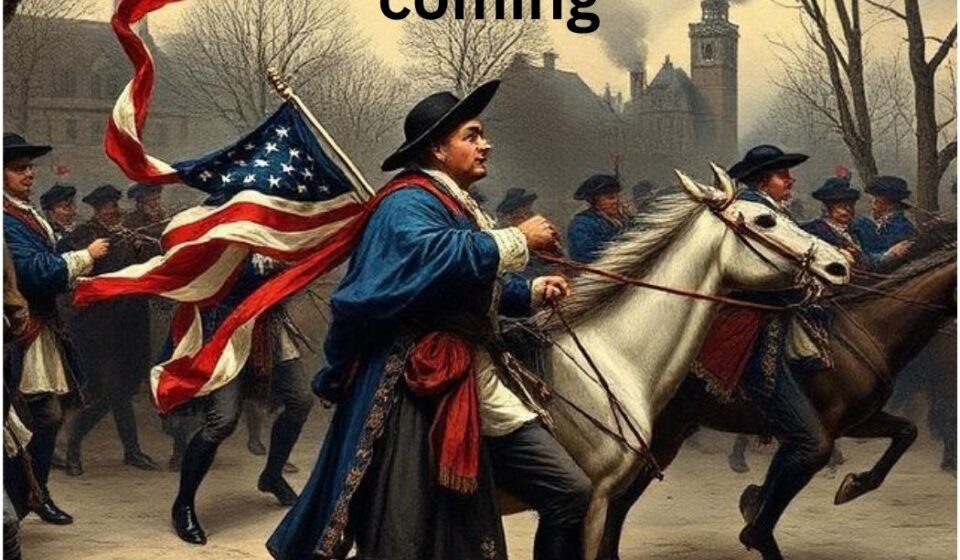

The story of Paul Revere’s midnight ride is etched into American memory. We can almost hear the frantic hoofbeats and the famous cry echoing through the night. But here’s the surprising truth: Paul Revere never shouted “The British are coming.”
This revelation often shocks people. That iconic line is so deeply woven into our cultural fabric that it’s hard to imagine it being anything but historical fact. Yet, the real story of that fateful night on April 18, 1775, is even more fascinating than the legend.
Table of Contents
ToggleThe Real Warning: Why “The British are coming” Makes No Sense
To understand the clandestine operation on the night before the Battles of Lexington and Concord, we have to set aside Hollywood’s version.
Historians agree that the mission’s was a quiet one, as British patrols were everywhere and secrecy was paramount. But the biggest clue lies in the language itself: In 1775, most American colonists still considered themselves British subjects loyal to the King, but outraged by Parliament’s “taxation without representation”. Shouting that “the British are coming” would have been confusing at best to fellow citizens who still felt British.
So, what was the real rallying cry that night? Accounts from the time show that Revere and the other riders used the contemporary military terms for the enemy. They warned of the approach of the “Regulars” (which referred to the British army’s professional soldiers), the “Redcoats” (a reference to their iconic uniforms), or “the King’s men“. One of Paul Revere’s most famous surviving warnings was, in fact, “The Regulars are coming out! “.
Longfellow and The Atlantic: The Birth of a National Myth
If Revere didn’t say it, how did this misquote become so famous? The answer lies not in 1775, but nearly a century later, in a poem designed to save a nation.
In 1861, as the United States teetered on the brink of Civil War, celebrated poet Henry Wadsworth Longfellow published “Paul Revere’s Ride” in The Atlantic Monthly magazine. As an ardent abolitionist, Longfellow was deeply concerned about the Union’s future. More than a history lesson, his poem was a calculated piece of art created to forge a patriotic national myth: to remind a fractured country of its shared heroic past and galvanize people to fight for freedom again.
To achieve this, Longfellow took artistic liberties. He dramatically simplified events and made Revere the unforgettable, lone hero. The poem was a smash hit, and its rousing, memorable lines—like the warning cry—became the accepted truth in the public’s imagination, cementing Paul Revere as America’s ultimate patriot.
A Cast of Heroes: The Real Midnight Riders
Longfellow’s poem made Revere a superstar, but the real operation was a team effort involving several brave men:
-
William Dawes: A tanner and fellow Patriot sent on a separate, longer land route to warn Lexington. He arrived about a half-hour after Revere. Often forgotten, many joke he didn’t get his due “because his name was harder to rhyme”.
-
Dr. Samuel Prescott: A young physician who joined Revere and Dawes en route. When a British patrol stopped the group, he cleverly escaped and became the only rider that night to complete the entire mission, successfully delivering the warning all the way to Concord.
-
🇺🇸 Sybil Ludington: The “female Paul Revere,” this 16-year-old rode over 40 miles through New York’s Putnam County in 1777—twice as far as Revere—to rally militia after a British attack, but her bravery often goes unrecognized.
-
Israel Bissell: An express rider who galloped an astounding 345 miles from Massachusetts to Philadelphia over five days, spreading the news of the first battles and helping to unify the colonies.
-
John “Jack” Jouett: Dubbed the “Paul Revere of the South,” he made a daring 40-mile ride in 1781 to warn Thomas Jefferson that British cavalry were coming to capture him.
While Paul Revere was the central hero of Longfellow’s famous poem, many other riders like William Dawes, Samuel Prescott, Sybil Ludington, and Israel Bissell played crucial roles in spreading the alarm and rallying the colonial militias.
The True History Is Still a Great Story
While history shows Revere didn’t make that famous cry, does that make the real story any less heroic? By no means. His actions on the night of April 18-19, 1775, were undeniably brave. Tasked by Dr. Joseph Warren, he coordinated lantern signals to warn of the British advance (“One if by land, and two if by sea”) before rowing across the Charles River to begin his ride. He alerted Hancock and Adams before being captured by a British patrol—and even then, he brazenly tried to bluff them by claiming the whole countryside was up in arms.
Ultimately, the “fact versus fiction” debate is precisely what makes the ride so powerful. The real story is a testament to courage, cunning, and the power of a collective effort. The legend—crafted by Longfellow—is a testament to the power of story itself. Our job is to appreciate both for what they are. Next time you hear the cry “The British are coming!”, you’ll know it’s a poem, not a primary source—and that the truth behind it is just as thrilling. It’s a story that, in the end, is still ours to tell.

admin
M Umer Abbasi is a luxury lifestyle journalist and editorial curator specializing in haute horology, passion investments, and avant-garde design. With an eye for flawless craftsmanship and heritage storytelling, he deconstructs the world of high-ticket assets—from secondary watch market trends to the evolution of bespoke tailoring. His work focuses on shifting the luxury narrative away from fleeting trends and toward timeless design, raw materials, and true artisanship.