
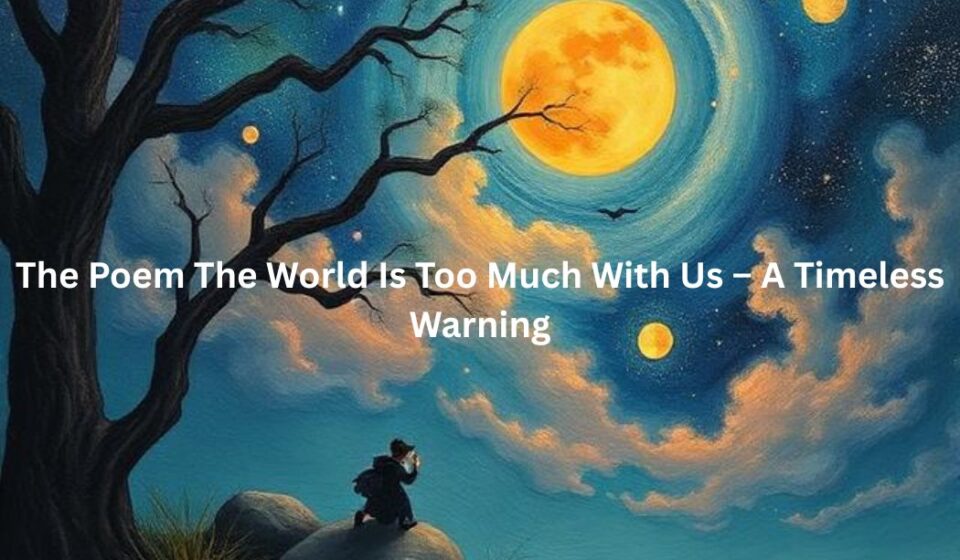

First published in 1807, William Wordsworth’s sonnet “The World Is Too Much With Us” reads as if it could have been written yesterday. Its opening line has become a cultural shorthand for burnout, consumerism, and our collective distance from nature.
But Wordsworth wasn’t just complaining about a busy schedule. He was issuing a warning—one that has aged like fine wine (or perhaps like plastic in a landfill).
In this post, we’ll break down:
-
A full summary of the poem
-
Key themes and meanings
-
Literary devices Wordsworth employs
-
Why it still matters in the 21st century
Let’s dive in.
The Poem: Full Text
The world is too much with us; late and soon,
Getting and spending, we lay waste our powers;
Little we see in Nature that is ours;
We have given our hearts away, a sordid boon!
This Sea that bares her bosom to the moon;
The winds that will be howling at all hours,
And are up-gathered now like sleeping flowers;
For this, for everything, we are out of tune;
It moves us not.—Great God! I’d rather be
A Pagan suckled in a creed outworn;
So might I, standing on this pleasant lea,
Have glimpses that would make me less forlorn;
Have sight of Proteus rising from the sea;
Or hear old Triton blow his wreathèd horn.
(14 lines — a Petrarchan sonnet)
Summary: What’s Really Going On?
The speaker opens with a bold accusation: humanity has lost its connection to the natural world. We are consumed by “getting and spending”—earning money, buying things, chasing status. This obsession has drained our spiritual and emotional energy.
As a result, we no longer feel moved by nature’s beauty. The sea, the howling winds, the flowers—none of it “moves us.” We are, in Wordsworth’s unforgettable phrase, “out of tune.”
The speaker then makes a radical wish: he would rather be a pagan—someone who worships multiple nature gods—than a modern, civilized Christian who ignores the earth. Why? Because pagans at least saw divinity in nature. They could imagine Proteus (a shape-shifting sea god) rising from the waves or Triton (a merman herald of the sea) blowing his conch shell horn.
That mythological vision, the speaker argues, would bring him more joy and meaning than the numb, money-driven life he sees around him.
Key Themes (For Students & Enthusiasts)
1. Materialism vs. Spirituality
Wordsworth directly attacks the emerging capitalist/industrial mindset. The phrase “sordid boon” is an oxymoron—a dirty gift. Our ability to earn and spend is supposed to be a benefit, but it has become ugly and corrupting.
2. Alienation from Nature
The speaker laments that we see “little…in Nature that is ours.” He’s not saying we don’t own land—he’s saying we don’t feel kinship with it. Nature has become an object to use, not a living presence to relate to.
3. Nostalgia for Mythology
This is the poem’s most surprising move. Wordsworth, a Christian Romantic, says he’d prefer pagan superstition over modern indifference. Why? Because mythology at least paid attention to the sea, the wind, the earth. Any living connection is better than none.
4. The Romantic Protest
This poem is a classic Romantic manifesto: emotion over reason, nature over industry, imagination over calculation. Wordsworth and his peers saw the Industrial Revolution destroying something precious.
Literary Devices (Analyze Like a Pro)
| Device | Example from the Poem | Effect |
|---|---|---|
| Apostrophe | “Great God!” (line 9) | Direct address to an absent deity—shows desperation |
| Oxymoron | “sordid boon” (line 4) | A “gift” that is actually filthy/ruinous |
| Personification | “This Sea that bares her bosom to the moon” | The sea is a living, vulnerable woman |
| Allusion | Proteus & Triton (lines 13-14) | Greek sea gods—represent awe and mystery |
| Iambic pentameter | Entire poem (mostly) | Creates a rhythmic, meditative flow |
| Enjambment | Lines 5-7 | The sentence flows past line breaks, mirroring natural movement |
Pro Tip: When writing an essay on this poem, focus on the tension between form (a strict sonnet) and content (a wild desire to abandon Christianity for paganism).
Modern Relevance: Why This Poem Is Everywhere in 2024-2025
You’ve seen this poem quoted in:
-
Climate change activism (Naomi Klein’s This Changes Everything)
-
Digital minimalism blogs (“Getting and spending” is now scrolling and buying)
-
Ecopsychology (the idea that nature-deficit disorder is real)
Consider:
-
Social media – We give our hearts away for likes. A sordid boon indeed.
-
Burnout culture – “Late and soon, getting and spending” describes the gig economy perfectly.
-
Nature therapy – The poem predicts the rise of forest bathing, ecotherapy, and “attention restoration theory.”
The question Wordsworth asks is urgent: If we lose every god, every myth, every sense of the sacred in a crashing wave—what’s left? Just a spreadsheet and a phone battery at 4%.
Discussion Questions (For Class or Comments)
-
Is Wordsworth being fair to Christianity? Or does he misrepresent it as “anti-nature”?
-
Can you think of a modern equivalent to his pagan longing? (e.g., people who say they’re “spiritual but not religious”)
-
The poem blames humanity collectively. Do you think individuals are powerless to change this? Or is it a choice?
-
Would Wordsworth have hated the national park system? (It preserves nature but also commodifies it.)
Conclusion: A Sonnet That Won’t Let Us Off the Hook
“The World Is Too Much With Us” is not a gentle nature poem. It’s an accusation. It’s a confession. And it’s a plea.
Wordsworth doesn’t offer easy solutions. He doesn’t say “go for a walk and you’ll feel better.” Instead, he says we’ve already given our hearts away—and only a radical reimagining of what deserves our wonder can save us.
The sea still bares her bosom to the moon. The winds still howl. But are we listening?
Or are we too busy getting and spending to notice?